

Golden Thread Guidance

A practical 5-part guide series for building safety accountability
The Golden Thread is not a document, a platform, or a checklist.
It is a way of organising, maintaining, and trusting building safety information over time.This guidance series explains what the Golden Thread really is, why it exists, where it commonly breaks down, and how to manage it calmly and confidently across a building’s lifecycle.

Whether you are an Accountable Person, Principal Accountable Person, Managing Agent, or part of a facilities or compliance team, these guides are designed to give you clarity without jargon or unnecessary complexity.
What is the Golden Thread?
The Golden Thread is the complete, accurate, and up-to-date record of information needed to understand and manage fire and structural safety risks in a building.
It ensures that the right people have the right information, at the right time, in a form they can rely on.
Under the Building Safety Act, it is how duty holders demonstrate control, competence, and oversight.
Why This Guidance Exists
Many organisations struggle with the Golden Thread not because they lack documents, but because:
-
Information is scattered across systems and suppliers
-
Responsibility is unclear or changes over time
-
Records exist but cannot be trusted
-
Compliance activity is reactive rather than planned
This series is designed to cut through confusion and help you build a Golden Thread that actually works in practice, not just in theory.
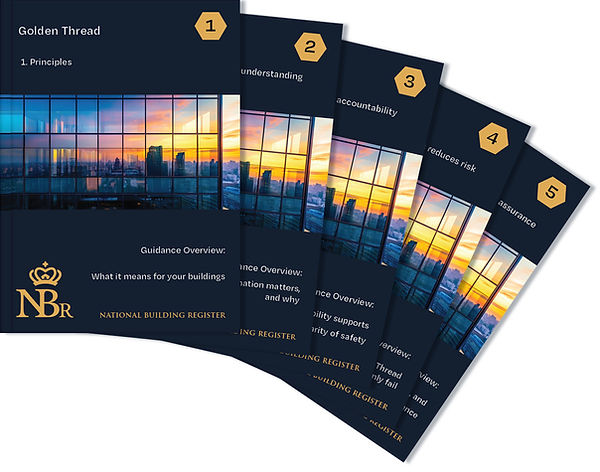
The Golden Thread Guidance Series
Guide 1: Principles
What the Golden Thread is, why it exists, and what it is not
Purpose: orientation and myth-busting
This guide establishes the foundations, challenges common misconceptions, and explains how the Golden Thread fits within the Building Safety Act without turning it into a paperwork exercise.
Guide 2: What Information Matters, and Why
Understanding information purpose, not just document types
Purpose: clarity on information types and intent
Rather than listing documents, this guide explains what information genuinely supports safety decisions, why it matters, and how to think about quality, relevance, and use.
Guide 3: Responsibilities, Roles, and Accountability
Who owns what, and when that ownership changes
Purpose: clarity on accountability
This guide explains responsibilities across PAPs, APs, managing agents, FM teams, and others. It also covers ownership change, sales, leases, insurance considerations, and handover risks.
Guide 4: Where Golden Thread Arrangements Commonly Fail
The real-world breakdown points
Purpose: honest diagnosis
This guide identifies where Golden Thread arrangements typically fail, including system fragmentation, poor handovers, missing evidence, and moments of heightened risk.
Guide 5: Stewardship, Structure, and Long-Term Confidence
Keeping the Golden Thread working without constant effort
Purpose: long-term sustainability
This guide focuses on calm, sustainable stewardship. It explains how to structure information, assign responsibility, and maintain confidence over time without relying on individuals or fire-fighting compliance.
Who This Series Is For
This guidance is written for organisations responsible for occupied higher-risk buildings, including:
-
Principal Accountable Persons
-
Accountable Persons
-
Managing Agents
-
Building Owners
-
Facilities and compliance teams
It is suitable whether you are early in your Building Safety Act journey or seeking to strengthen existing arrangements.
Download the Golden Thread Guidance Series
Access the full 5-part Golden Thread Guidance series to gain practical clarity, reduce compliance risk, and build long-term confidence in your building safety information.
NBR guides are published to support clarity, consistency, and confidence across the property sector.
They reflect publicly available legislation and statutory guidance and are intended to support understanding and good practice. They are not legal advice and should always be read alongside the latest guidance published by the Building Safety Regulator and GOV.UK.
Where information is treated with care, structure, and accountability, safety management becomes predictable, defensible, and sustainable.
More building safety guidance
Explore our full Knowledge Hub for guidance on Safety Cases, statutory dutyholder roles, handover information, and resident engagement.